Advanced Polymers and Biomaterials
Biological interfaces with controlled properties
Biological systems are sensitive to surface properties such as chemical, geometry and topological properties. To achieve control over interactions at the interface of biological systems and their environment, the development of materials in which individual properties can be manipulated at the micro-and nanometer scale is of great importance. The department of Advanced Polymers and Biomaterials focuses on the targeted synthesis of such materials through manipulation of chemical and physical properties and the study of these materials in biological systems. To this end, we apply advanced synthesis methods, such as Chemical Vapor Deposition, Electrohydrodynamic-co-Jet Writing and controlled polymerization techniques. The optimization of the structure-property-relationship of these systems is enabled by multi-modal materials characterization. Besides widely-applied surface analysis techniques (Optical microscopy, IR-techniques, AFM, SEM,…) we focus on Spectroscopic Imaging Ellipsometry and TOF-SIMS to reveal the topological and chemical properties of the materials.
We closely cooperate with our US-sister group, the Lahann Lab at University of Michigan.
Working groups
Precision Synthesis of Biomaterials and Biointerfaces
Synthesis of organic substances (such as functionalized [2.2]Paracyclophanes and pyridinophanes, organic linkers and keteneacetale) and functionalized monomers (e.g. zwitterionic monomers and lactones), Synthesis of polymers (i.e. Controlled radical polymerization). Chemical Vapor Deposition (CVD) Polymerization, Surface modification by means of controlled polymerization and click chemistry, Generation of micro- and nanostructured substrates, Electrohydrodynamic co-jetting of particles and fibers.
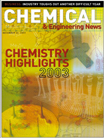
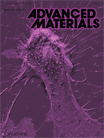
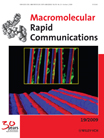
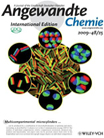
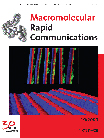
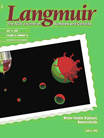
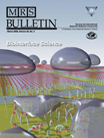
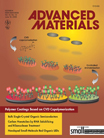
Coverarticles
 |
 |
 |
 |
 |
 |
 |
 |
 |
 |
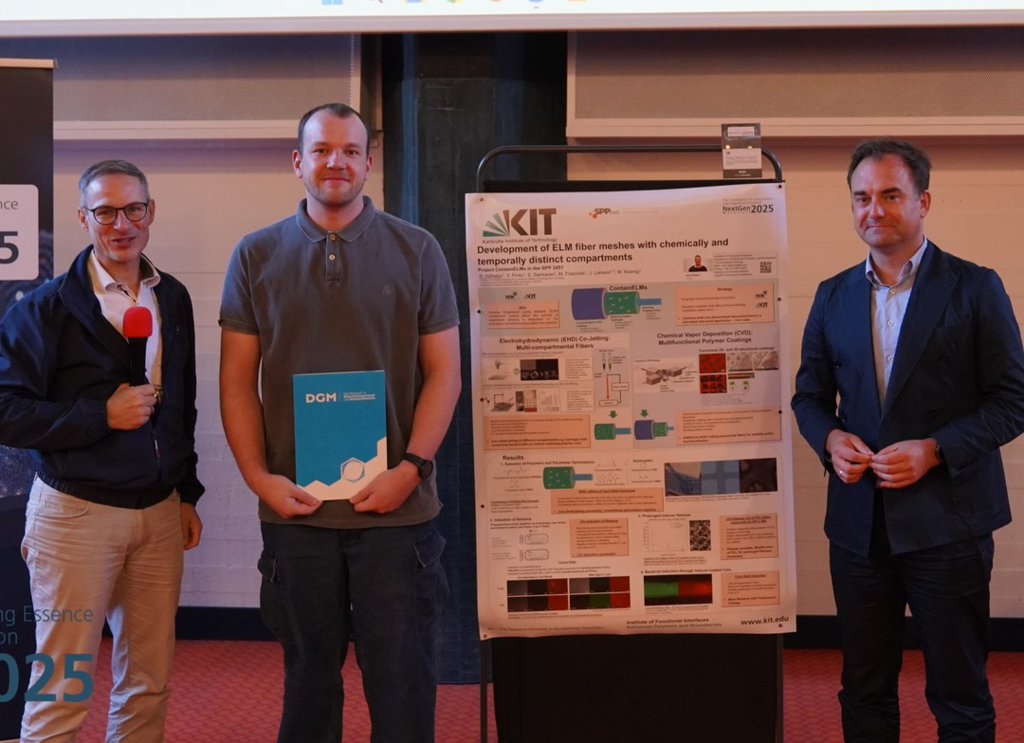
Robin Wilhelm, doctoral student working in the department of Advances Polymers and Biomaterials, won the third poster price at the NextGenMaterials conference organized by the German Society for Materials Science (DGM) in Hamburg. His poster on “Development of Engineered Living Material fiber meshes with chemically and temporally distinct compartments” presents his efforts to create multi-compartmental fibers for the safe encapsulation and thus widespread usage of genetically modified organisms as part of a collaborative project with the Synthetic Biology-Team of Dr. S. Sankaran of the INM Saarbrücken. Congratulations, Robin!
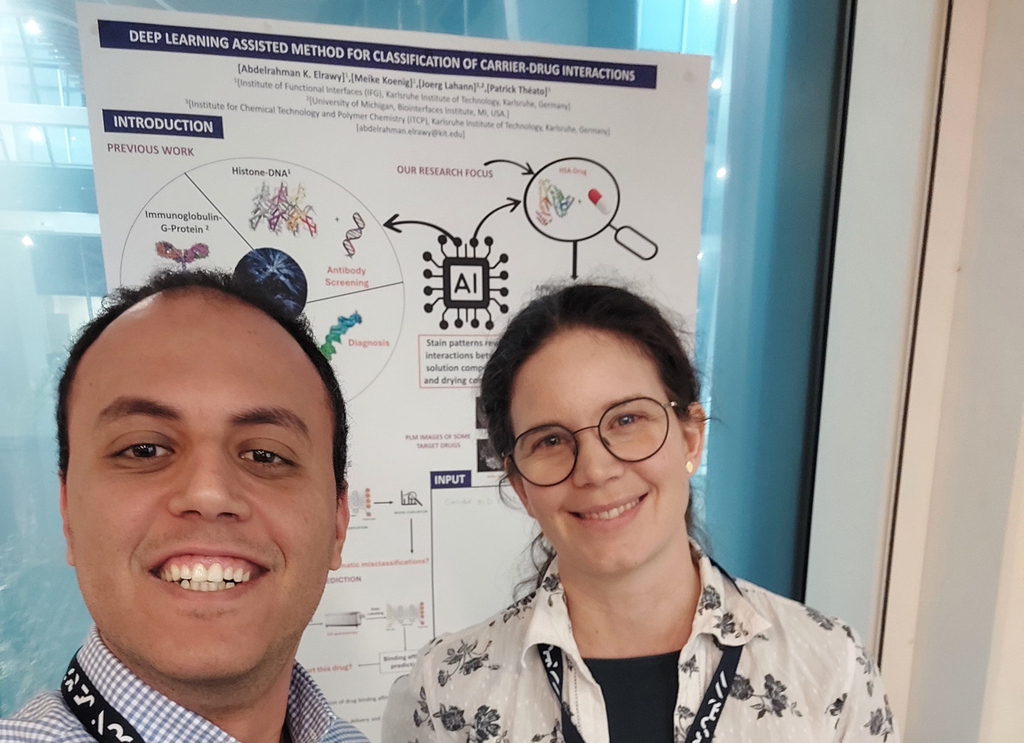
Within the frame of the EU-funded Marie Skłodowska-Curie Innovative Doctoral Network NanoRAM, we started a project on "Digitalization of Biomaterial Research via Deep Learning Approaches". Strongly collaborating with other groups across Europe and beyond, we will investigate drug-carrier interactions applying deep-learning methods.
Link_more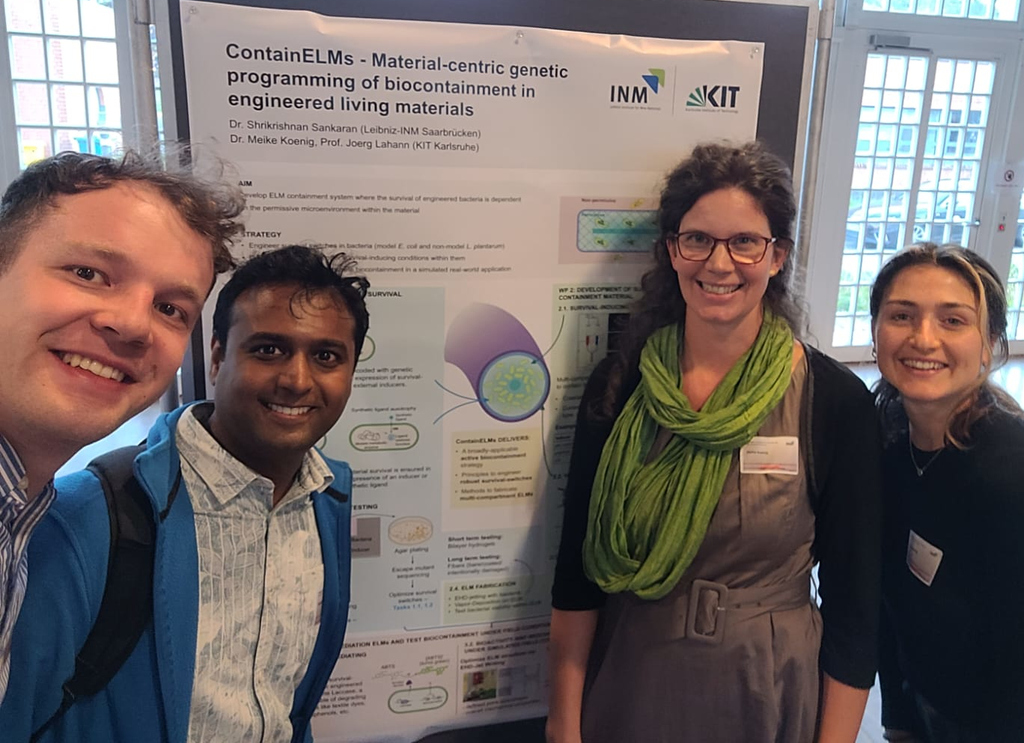
Within the frame of the SPP 2451 "Engineered Living Materials with Adaptive Functions", we started the project "ContainELMs". Together with Dr. Shriskrishnan Sankaran and Victoria Pinto from the INM – Leibniz Institute for New Materials in Saarbrücken, Robin Wilhelm and Dr. Meike König will work towards a safe usage of engineered organisms. For this we will develop materials with controlled internal properties using Electrohydrodynamic Co-Jetting and Chemical Vapor Deposition.
SPP 2451: Project ContainELMs